
RPE vs RIR: What Should You Record in Your Workout Log?
RPE and RIR are both simple effort markers. Learn the practical difference, choose one scale, and use it consistently in your strength-training log.
RPE and RIR are two ways to record how hard a set felt. RPE describes perceived effort on a scale; RIR describes how many more good reps you think you had left. Neither is a laboratory measurement, and neither needs to be. The practical goal is to make your workout history more comparable than load and reps alone.
The simple difference
- RPE asks, “How hard was that set?” On the common strength-training scale, a 10 is a maximal effort and lower numbers leave more room.
- RIR asks, “How many more clean reps did I have?” Zero RIR means no more reps were available with the intended standard.
The scales are related, but you do not need to memorize a perfect conversion. A rough practical relationship is:
| RIR | Approximate RPE | Plain-language cue |
|---|---|---|
| 3 | 7 | Challenging, but clearly more there |
| 2 | 8 | Hard, with two clean reps left |
| 1 | 9 | Very hard; one more clean rep possible |
| 0 | 10 | Maximal effort for the intended standard |
Treat this as a communication tool, not a promise of precision. Different exercises, technique standards, and fatigue can change how the same number feels.
Pick the scale you will actually use
RIR can be intuitive if you naturally think in remaining reps: “I had two more.” RPE can be easier if you think in effort: “That was an eight.” Both work when you apply them consistently.
Pick one for a training block. Switching between scales constantly makes the history harder to read. You can also use a plain-language backup note such as last rep slow when you are not confident in a number.
Record effort beside the set
The most useful format is compact:
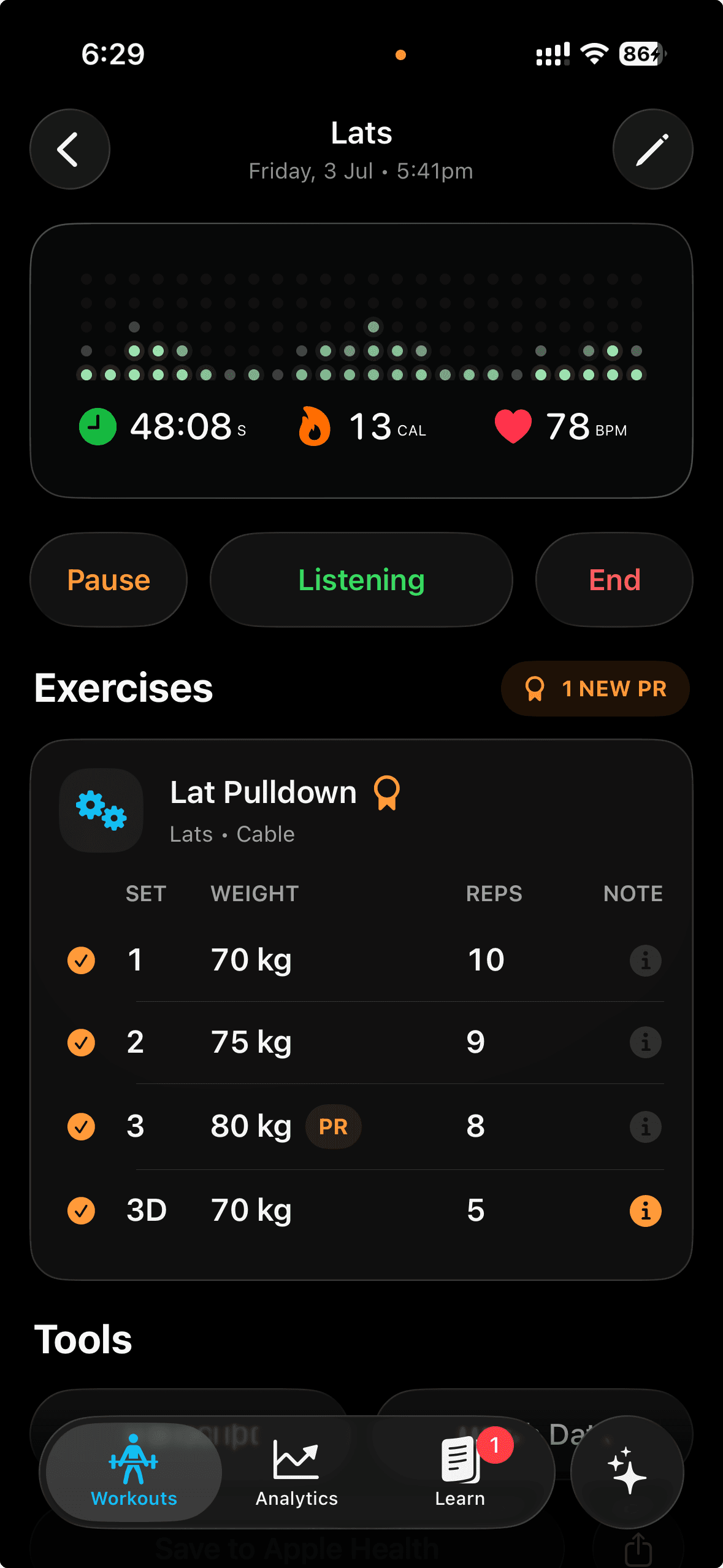
Lat pulldown — 80 kg × 8, 1 RIRBench press — 70 kg × 10, RPE 8Cable curl — 20 kg × 12, last rep slow
Add a technique or context note only when it changes the interpretation: short rest, grip slipped, or range improved. The guide on what to write in a workout journal explains the rest of the useful fields.
Use effort to guide progression
Suppose you hit the same load and reps as last week. If the set moved from RPE 9 to RPE 8 with clean technique, that is useful progress even though the visible numbers did not change. If a set reached the rep target at RPE 10 after poor rest, adding load may not be the best next action.
That is why effort belongs beside a progressive-overload record. It gives context for whether to add a rep, add load, repeat, or make the session easier.
Do not turn effort into a verdict on your body
RPE and RIR are training notes, not medical tools. A high-effort set can be normal; pain, dizziness, or unusual symptoms deserve a different response. Stop and seek qualified guidance when appropriate rather than treating a journal number as clearance to continue.
Capture the note while it is fresh
Effort is easy to forget after the next exercise. You can say “two reps left” or “that was an eight” when you log a workout by voice, then review it later with the rest of the session. If you use Apple Watch during the workout, the sets-and-reps workflow keeps that quick capture close to the set.
The best scale is the one that helps you make a calmer, more comparable decision next time. Start with one number or one short phrase, use it consistently, and let the history do the work. The broader workout-journal system shows where effort fits alongside sets, reps, notes, and the next target.
Explore Gyornal to capture effort, reps, load, and notes in one session record instead of relying on memory after the workout ends.
Keep reading
More practical guides for building a workout history you can use.
Workout Log Template for Strength Training: Sets, Reps, RPE, and Notes
Use this simple strength-training workout log template to capture actual sets, reps, load, effort, context, and the next-session target.
Read articleHow to Track Progressive Overload Without a Spreadsheet
Use a simple exercise history, repeatable rep-range rules, effort notes, and a next-session target to track progressive overload without spreadsheet upkeep.
Read articleWhat to Write in a Workout Journal After Every Set
Record the few details that make a strength-training log useful: load, reps, effort, technique, context, and the next-session decision.
Read article