
Stop Typing Between Sets: Why Voice-First Logging Actually Sticks
Voice workout logging keeps lifters consistent because it removes the friction of typing between sets. Learn how Gyornal turns speech into structured gym data on iPhone and Apple Watch.
Most people abandon workout tracking around set three, not because they lack discipline, but because logging breaks the rhythm of training. Voice-first workout logging fixes the input problem: you speak a set, Gyornal structures it, and you get back under the bar.
The real reason tracking apps fail in the gym
Spreadsheets and note apps assume you have dry hands, free attention, and thirty seconds between sets. In practice, you are chalked up, breathing hard, and trying to keep rest periods honest.
That gap shows up in every abandoned Strong or Hevy streak. The app is fine. The workflow is not. Typing "62.5 x 10, controlled stretch" on a glass screen after a hard set is friction you feel immediately.
Gyornal starts from a different assumption: the best log is the one you can capture without breaking flow.
What voice logging looks like in a real session
During an active workout, you speak naturally:
- "Lat pulldown, 62.5 for 10"
- "Same weight, 9 reps"
- "60 kilos for 10, controlled stretch with no jerking"
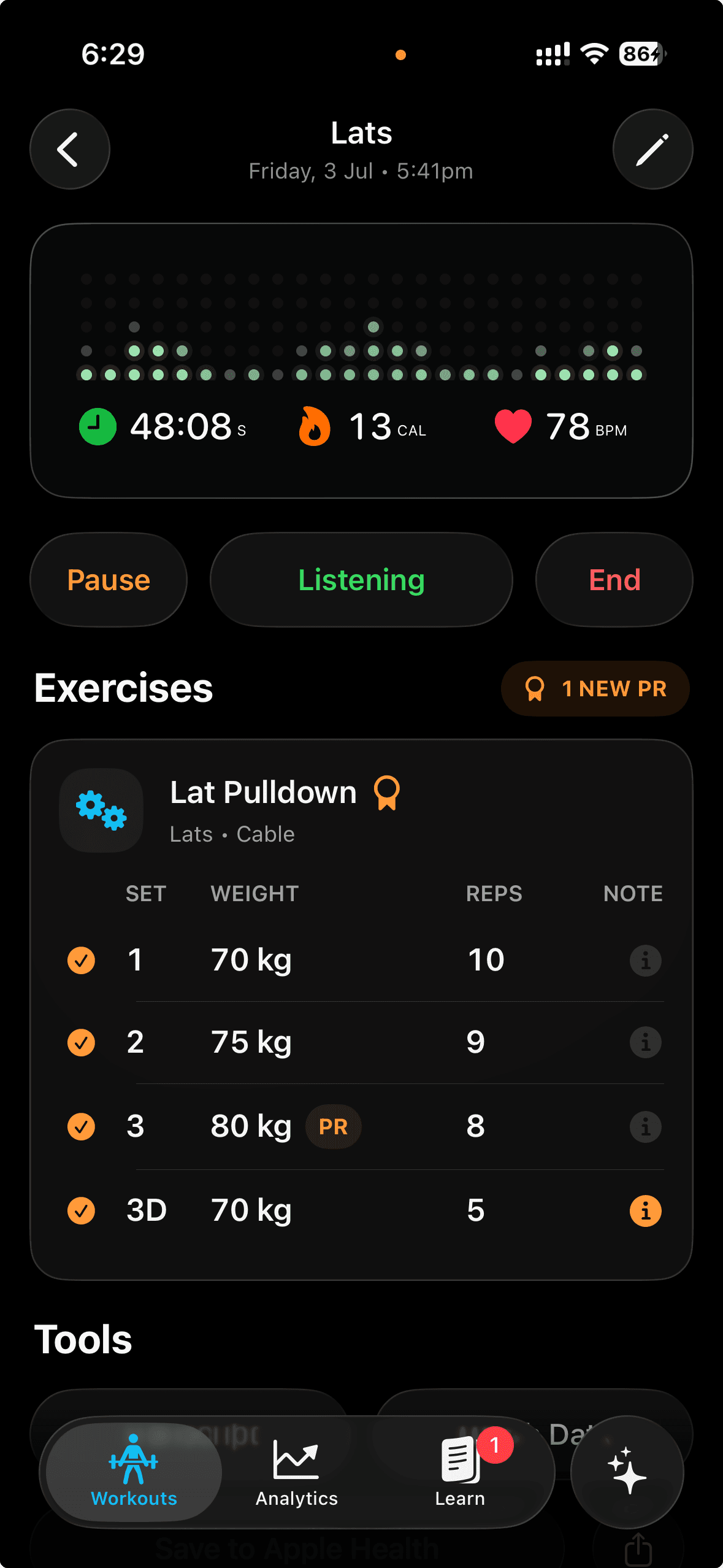
Gyornal listens during the session and turns that speech into structured sets: exercise, load, reps, and notes. You can correct on the fly with phrases like "actually, make that 9 reps."
This is not a party trick. It is the core workflow in Gyornal's beta launch: start a Pull Day, speak sets, and keep moving.
Why notes matter as much as numbers
Set quality is not only weight and reps. Lifters care about tempo, grip, ROM, and how a joint felt. Those details rarely survive a rushed tap-only log.
When you say "controlled stretch with no jerking" on set three, that note becomes part of your training memory. Later, it shows up in your session review and helps explain why you adjusted load or technique.
That is why Gyornal treats voice as more than dictation. Speech is how you capture context while your hands are on the bar.
Apple Watch changes where logging happens
Phone-on-bench is a bad default in a busy gym. Gyornal keeps the same session alive on Apple Watch with HealthKit while your phone stays in your bag.
On the wrist, you can:
- Continue the workout that started on iPhone
- Log sets with wrist-glance mic activation
- See the latest exercise, reps, and notes without pulling out your phone
- End the session and sync back to iPhone for review
The point is not "AI on your watch." The point is logging where you actually are when the set ends.
For the full wrist-first workflow, read how to log sets and reps on Apple Watch. Apple Watch is most useful as a fast capture surface; the iPhone remains the better place to review a transcript, edit a longer note, and compare the full session afterward.
When voice logging works best
Voice-first logging is strongest during active sessions when pace matters. It is less useful for:
- Detailed post-session analysis you want to write slowly
- Programs you are planning days in advance
- Replacing deliberate reflection after training
Gyornal is honest about that split. Speak during the workout. Review the transcript, Learn report, and history afterward.
The environment matters too. Music, equipment, and distance from the microphone can make any voice workflow less reliable. Keep each phrase short, confirm the exercise, load, and reps before the next set, and correct anything that is wrong while the set is still fresh. Our guide to hands-free workout tracking in a loud gym covers that practical fallback.
How this differs from generic fitness AI
Many apps lead with chatbot coaching. Gyornal leads with input method innovation for people who already want to journal.
You are not asking an AI to invent a leg day from scratch mid-session. You are telling Gyornal what you did so your history stays accurate. Coaching comes second, grounded in what you actually logged.
A workflow you can keep
If you have quit tracking before, the issue may not be motivation. It may be typing between sets.
Gyornal removes that step:
- Start a session on iPhone or Apple Watch
- Speak sets and short notes while you train
- Let the session sync across devices automatically
- Review structured data and transcript after the workout
That is how voice workout logging becomes a habit instead of a chore.
Try Gyornal
Gyornal is in early beta for iPhone and Apple Watch. If you want a gym journal that respects flow, start with voice-first logging and build from there.
Learn more about Gyornal or explore our guide on why workout notes matter more than generic AI advice.
To connect fast capture with a review habit, start with how to keep a workout journal. Voice is the input method; the useful part is the training history you build from it.
Keep reading
More practical guides for building a workout history you can use.
Hands-Free Workout Tracking in a Loud Gym: What Actually Works
Voice workout logging can work in a noisy gym when capture is brief, confirmation is visible, and corrections are easier than pretending every transcript is perfect.
Read articleHow to Log Sets and Reps on Apple Watch Without Your Phone
A practical Apple Watch workflow for keeping exercise, sets, reps, load, and notes in your lifting history while your phone stays out of the way.
Read articleApple Watch Strength Training: Which Metrics Actually Matter?
Apple Watch can preserve useful session context for lifting, but sets, reps, load, effort, and notes are what make a strength history actionable.
Read article