
How to Track Progressive Overload Without a Spreadsheet
Use a simple exercise history, repeatable rep-range rules, effort notes, and a next-session target to track progressive overload without spreadsheet upkeep.
You do not need a spreadsheet to track progressive overload. You need a comparable record of the lift, a clear rule for what counts as progress, and a next-session decision. The practical record is smaller than most people expect: exercise variation, load, reps, effort, context, and the target for the next exposure.
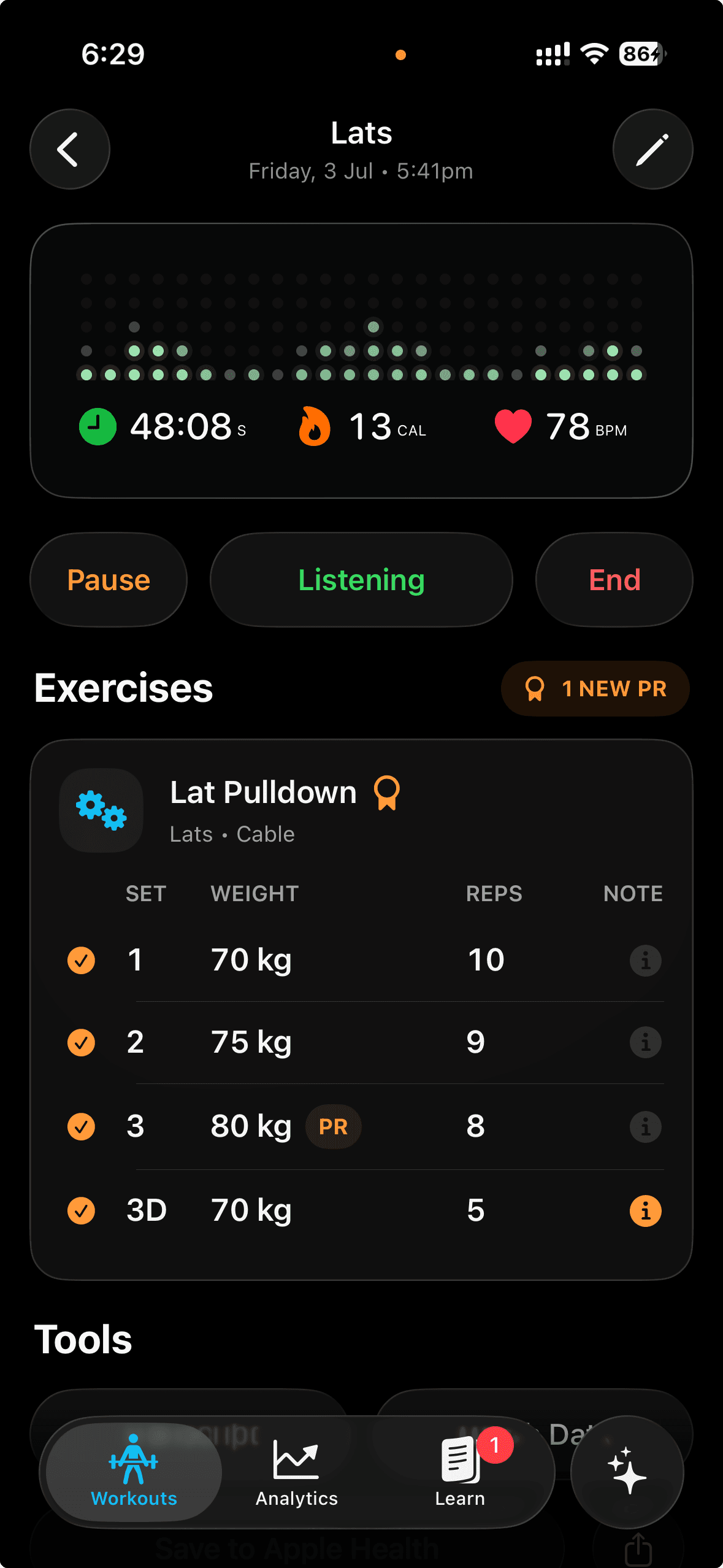
Progressive overload is a gradual increase in training demand over time. That can include more load, more repetitions, more productive sets, a better range of motion, or less rest. Cleveland Clinic’s progressive-overload overview makes the same point: the method is not limited to adding weight every session.
Keep one comparable history for each lift
The basic record for a lift is:
- exact variation,
- working-set load and actual reps,
- effort marker,
- useful context,
- next-session target.
Without the variation and context, the comparison can be misleading. A chest-supported machine row is not automatically comparable with a cable row. The same reps after half the rest time do not mean the same thing as the previous session.
Use the workout-journal system to keep the record consistent. If you need a copyable structure, start with the strength-training workout log template.
Choose a simple progression rule
For many hypertrophy-oriented lifts, a rep range is easier to sustain than a rigid load jump. For example:
- Choose a target of 8–10 reps for three working sets.
- Keep the same load until all three sets reach the top of the range with acceptable execution.
- Add the smallest practical load increase.
- Repeat the process.
If a lift moves from 70 × 8, 8, 7 to 70 × 10, 9, 8, that is progress even before the plates change. If you add weight but lose range, control, or too many reps, the apparent progression may not be useful.
Use effort to interpret the numbers
Load and reps are the starting point, not the entire story. A set of ten with two reps in reserve is different from a set of ten that barely moved. RPE or RIR helps you remember the difference without writing a full paragraph.
You do not need false precision. A consistent “hard but clean” note can be useful. The RPE versus RIR guide explains how to use either system without turning your training log into a scoring exercise.
Make one decision after each session
At the end of an exercise, choose one next action:
- add a rep,
- add a small amount of load,
- repeat the prescription,
- improve the execution standard,
- use a longer rest,
- or reduce the target while you recover.
That decision is the value of the record. You are not trying to prove that every session was better. You are trying to make the next one more intentional.
Do not confuse fatigue with regression
Performance can move for ordinary reasons: a different machine, poor sleep, rushed rest, a crowded gym, or a changed exercise order. Put a short note beside the set if that context matters. The guide on what to write in a workout journal gives examples that protect the comparison without creating clutter.
If you have unusual pain, dizziness, or symptoms that concern you, do not try to “progress through” them with an app or spreadsheet. Stop and seek qualified guidance.
Review trends, not only personal records
A personal record can be motivating, but a useful trend is broader:
- Are you repeating the same exercise variation?
- Are the reps becoming more reliable at the same load?
- Is the effort becoming more manageable?
- Are technique notes improving?
- Are you recovering well enough to repeat productive work?
Gyornal keeps these facts in the session history so your review can start from what you actually logged. Voice capture helps when typing is the bottleneck; see why voice workout logging actually sticks for the capture side of the workflow.
A four-session example
| Session | Top set | Effort/context | Next target |
|---|---|---|---|
| 1 | 70 kg × 8 | RPE 8 | Add one rep |
| 2 | 70 kg × 9 | RPE 8; cleaner range | Add one rep |
| 3 | 70 kg × 10 | RPE 8 | Repeat across all sets |
| 4 | 72.5 kg × 8 | RPE 8.5 | Keep load and build reps |
The record shows progress without a formula. It also shows why the next target is sensible.
Explore Gyornal to keep an exercise history that is fast to capture during training and useful when you decide what to do next.
Keep reading
More practical guides for building a workout history you can use.
How to Keep a Workout Journal That Actually Helps You Progress
A practical strength-training journal system for recording sets, reps, effort, notes, and the next decision without turning your workout into admin.
Read articleRPE vs RIR: What Should You Record in Your Workout Log?
RPE and RIR are both simple effort markers. Learn the practical difference, choose one scale, and use it consistently in your strength-training log.
Read articleWorkout Log Template for Strength Training: Sets, Reps, RPE, and Notes
Use this simple strength-training workout log template to capture actual sets, reps, load, effort, context, and the next-session target.
Read article